

Wondering about the income Winnipeg homebuyers need in 2026? Your required household income depends on the home’s purchase price, down payment, mortgage rate, existing debts, property taxes, heating expenses, and the lender’s qualification requirements.
For a home near Winnipeg’s 2026 average detached price, a household may need an annual gross income of approximately $94,000 with a 20% down payment or roughly $112,000 with a 5% down payment. These are illustrative estimates—not guaranteed qualification amounts—and assume limited additional debt, a 25-year amortization, estimated property taxes and heating expenses, and mortgage qualification at approximately 6.5%.
Before establishing a budget, buyers can explore current Winnipeg Homes For Sale and use a Winnipeg Home Finder to compare properties within different neighbourhoods and price ranges.
The actual income needed to buy a house in Winnipeg depends on the property price, down payment, mortgage rate, property taxes, heating expenses, condominium fees, existing debts, credit history, and lender requirements.
Understanding these variables before attending showings can help buyers establish a realistic price range. It can also help sellers recognize what financially qualified buyers may be able to afford in 2026.
Winnipeg House Prices Remain Resilient in 2026
According to the Winnipeg Regional Real Estate Board’s August 2026 market report, the year-to-date average price of a residential detached home reached $468,679. That was 3% higher than in 2025 and 8% above the five-year average.
The year-to-date condominium average price reached $288,834, which was 3% higher than the previous year. At the same time, residential detached sales declined by 7%, condominium sales fell by 10%, and August active listings across all property types increased by 13% year over year.
Buyers can review current Winnipeg Property Listings to see how prices, home styles, conditions, and available inventory differ throughout the city. A local Winnipeg Real Estate Agent can also provide recent comparable sales that may not be obvious from advertised listing prices alone.
Winnipeg’s citywide average provides a useful reference point, but it does not determine what every buyer must spend. The Board’s year-to-date detached averages ranged from approximately $356,987 in the West to $626,036 in the South West.
These regional differences can significantly affect the income required to purchase a property.
This demonstrates why the income Winnipeg homebuyers need can vary considerably between neighbourhoods, property types, and price ranges.
What Determines the Income Winnipeg Homebuyers Need?
The following examples provide general estimates of the gross household income required when purchasing a home with a 20% down payment.
| Home Price | 20% Down Payment | Estimated Mortgage | Approximate Household Income |
|---|---|---|---|
| $350,000 | $70,000 | $280,000 | $75,000–$80,000 |
| $400,000 | $80,000 | $320,000 | $83,000–$88,000 |
| $468,679 | $93,736 | $374,943 | $94,000–$100,000 |
| $500,000 | $100,000 | $400,000 | $99,000–$105,000 |
| $600,000 | $120,000 | $480,000 | $116,000–$123,000 |
These estimates assume:
- A 25-year amortization
- An illustrative mortgage rate of 4.5%
- Qualification at approximately 6.5% under the mortgage stress test
- Estimated annual property taxes of $4,500
- Estimated heating costs of $150 per month
- No condominium fees
- Little or no additional monthly debt
The required income can increase if a buyer has car payments, credit-card balances, student loans, support payments, higher property taxes, or condominium fees.
Buyers should obtain a personalized mortgage pre-approval before relying on a general affordability calculation. Once a price range has been established, professional MLS Listing Services can help identify suitable homes that match the buyer’s location, property type, and budget requirements.
How Your Down Payment Changes the Income Requirement
A larger down payment reduces the amount you need to borrow and can make mortgage qualification easier.
By reducing the mortgage balance, a larger down payment may also lower the income Winnipeg homebuyers need to qualify.
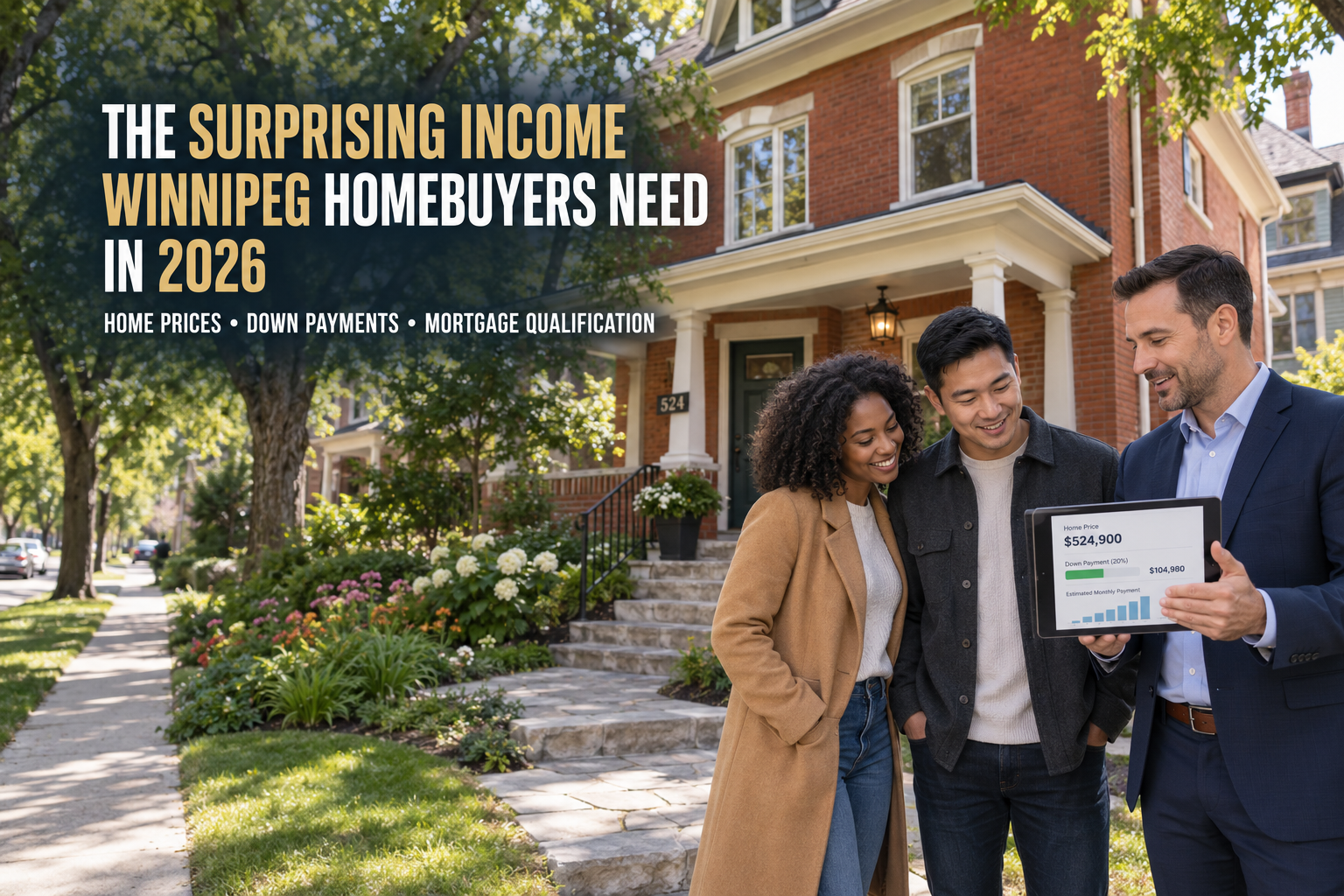
For a home priced at Winnipeg’s year-to-date detached average of $468,679, a 20% down payment would be approximately $93,736. The remaining mortgage before closing costs would be about $374,943.
Under the assumptions used in this article, the estimated household income needed would be approximately $94,000 to $100,000 annually, provided the applicants have minimal additional debt.
With a 5% down payment of approximately $23,434, the base mortgage would be substantially larger. Because the down payment is below 20%, mortgage default insurance would generally be required, and its premium is usually added to the mortgage balance.
After including an illustrative insurance premium, the financed amount could rise to approximately $463,000. The household could consequently require around $112,000 to $118,000 in gross annual income, depending on the lender’s calculations and the property’s expenses.
A smaller down payment also leaves less immediate equity in the property. Buyers should balance their desire to purchase sooner against the benefits of saving a larger amount.
This demonstrates why the income needed to buy a house in Winnipeg cannot be determined by the purchase price alone.
How the Canadian Mortgage Stress Test Affects Buyers
Canadian buyers generally must prove that they can manage payments at a rate higher than their actual mortgage rate.
For uninsured mortgages, the Office of the Superintendent of Financial Institutions states that borrowers are generally qualified using the greater of:
- The mortgage contract rate plus 2%; or
- 5.25%.
Therefore, a buyer receiving a 4.5% mortgage rate may need to qualify as though the rate were 6.5%. This does not mean the borrower pays 6.5%. Instead, it means the lender tests whether the borrower could continue making payments if rates or financial circumstances changed.
The OSFI minimum qualifying rate remained the greater of the contract rate plus 2% or 5.25% in 2026.
The stress test can noticeably reduce purchasing power, particularly for buyers with smaller down payments or significant monthly debts.
Mortgage Rates and Winnipeg Affordability in 2026
The Bank of Canada maintained its policy interest rate at 2.25% on September 2, 2026. However, the Bank also reported that global long-term bond yields had increased and financial conditions had tightened.
The overnight rate influences Canadian borrowing conditions, but fixed mortgage rates are also affected by bond yields, lender competition, mortgage features, and the applicant’s financial profile.
Buyers can compare available Lowest Mortgage Interest Rates, but the lowest advertised rate will not necessarily be the best mortgage for every situation. Prepayment privileges, penalties, portability, term length, restrictions, and customer service may all affect the mortgage’s long-term value.
Even a small rate change can affect monthly payments and the income required to qualify.
As mortgage rates change, the income Winnipeg homebuyers need may increase or decrease even when the purchase price remains the same.
A current pre-approval is valuable, but it is not permanent. Mortgage rates, debts, employment circumstances, and lender policies may change before an offer is submitted.
How Lenders Calculate Your Mortgage Affordability
Lenders generally examine two important ratios: Gross Debt Service and Total Debt Service.
The Gross Debt Service ratio, or GDS, measures the percentage of gross household income used for mortgage principal and interest, property taxes, heating expenses, and a portion of condominium fees when applicable.
The Total Debt Service ratio, or TDS, includes those housing expenses plus other financial obligations such as vehicle loans, student loans, credit-card payments, lines of credit, and support payments.
According to the Canada Mortgage and Housing Corporation, its limits are generally 39% for GDS and 44% for TDS.
For example, two households earning $100,000 may qualify for very different mortgage amounts. A household with no consumer debt may have considerably more purchasing power than one carrying large vehicle and credit-card payments.
Existing monthly debts can therefore increase the income Winnipeg homebuyers need for the same property.
Credit history, employment stability, the source of the down payment, and the property itself may also influence a lender’s decision.
Additional Costs Winnipeg Buyers Must Budget For
Mortgage qualification is only one part of home affordability. Buyers also need funds for the down payment, closing expenses, moving costs, and ongoing ownership.
Potential expenses include:
- Legal fees and disbursements
- Title insurance
- Manitoba land transfer tax
- Property-tax adjustments
- Home inspection expenses
- Mortgage default insurance when applicable
- Moving expenses
- Immediate repairs or improvements
- Home insurance
- Utility setup
- Furniture and appliances
- An emergency maintenance fund
Winnipeg’s winters can also produce substantial heating, snow-removal, insulation, roofing, and mechanical-system expenses. Buyers should carefully review the furnace, windows, roof, insulation, basement, grading, and signs of moisture before removing an inspection condition.
For additional preparation guidance, review these Home Buying & Selling Tips before beginning your search or submitting an offer.
Qualifying for a mortgage does not automatically mean the maximum available loan will feel comfortable within your monthly budget. Buyers should leave room for savings, maintenance, emergencies, transportation, food, and other living expenses.
How to Improve Your Winnipeg Home-Buying Power
If your current income is not enough for your preferred property, several strategies may improve your position.
First, reduce high-interest debt before applying. Lower monthly obligations can improve your TDS ratio and may increase the mortgage amount available to you.
Second, build a larger down payment. Borrowing less can reduce the monthly payment, lower the required qualifying income, and potentially eliminate mortgage default insurance when the down payment reaches 20%.
Third, consider a different home type or neighbourhood. Condominiums, attached homes, and properties in lower-priced areas may provide a more accessible entry point than Winnipeg’s overall detached-home average.
Remember to include condominium fees in your calculations. Lenders generally count 50% of applicable condo fees when assessing debt-service ratios.
Finally, avoid making large financed purchases or changing employment immediately before closing without discussing the potential effect with your mortgage professional.
A knowledgeable Top Winnipeg Realtor can help you compare neighbourhoods, property types, and prices after your mortgage professional establishes a suitable purchasing range.
What Winnipeg’s 2026 Market Means for Sellers
Affordability is also important to Winnipeg home sellers. The number of buyers who can qualify for a property often changes as home prices and mortgage rates move.
Winnipeg’s record year-to-date average prices suggest continued property-value strength. However, lower sales and higher active inventory in August indicate that buyers may have more choice and may compare value carefully.
A seller who prices substantially above comparable sales may exclude buyers whose pre-approval ends below the asking price. Accurate pricing, good property condition, professional presentation, and strong marketing can help attract financially qualified purchasers.
Working with a Winnipeg Top Real Estate Agent can help sellers examine recent neighbourhood sales, current competing listings, buyer activity, and property-specific features before selecting an asking price.
Sellers can also explore the Winnipeg Real Estate Blog for market updates, pricing guidance, preparation advice, and other information that may help them plan a successful sale.
Determine What You Can Comfortably Afford
For Winnipeg’s year-to-date average detached price of approximately $468,679, a household may need roughly $94,000 to $100,000 per year with 20% down, assuming minimal additional debt. With a smaller down payment and an insured mortgage, the estimated requirement could rise to approximately $112,000 or more.
These figures are examples rather than guarantees.
Ultimately, the income Winnipeg homebuyers need depends on their down payment, mortgage rate, debts, property expenses, credit profile, and lender requirements.
Before beginning your search, speak with a qualified mortgage professional and obtain a current pre-approval. You can then work with a Top Rated Realtor Winnipeg home buyers trust to compare suitable properties and make informed decisions.
Whether you are buying your first property, moving to another neighbourhood, or searching for Your Home in Canada, professional guidance can help you understand local prices, prepare a competitive offer, and choose a home that fits both your needs and your comfortable monthly budget.